
Cn
User login

Release Date:2026.08.20
On July 20, 2026, Chinese authorities approved 19 new products related to the Southern African Territories serotype 1 (SAT1) of foot-and-mouth disease (FMD)in a single batch.The products were developed by nine companies. Following the expedited launch of emergency vaccines in March, this approval represents a pivotal step in China’s transition from an emergency response to a long-term, routine SAT1 prevention and control strategy.
In March 2026, outbreaks of SAT1 FMD were reported in Ili Prefecture, Xinjiang, and Wuwei City, Gansu. This marked the first incursion of the serotype into China. The virus spread rapidly, infecting not only cattle and sheep but also pigs.
The outbreaks immediately put the entire swine industry on high alert. The O- and A-serotype FMD vaccines previously used in China offered no cross-protection against SAT1. Had the virus spread extensively through regions with high-density pig production, the consequences could have been devastating.
Yet China released its first batches of targeted vaccines less than two weeks after the outbreaks emerged. Behind this rapid response was more than a decade of technological development by China’s animal health companies. The approval of 19 additional products in July further demonstrates that the industry has moved beyond emergency response and established a broader preparedness framework.
Below, we highlight the animal health companies whose advanced technologies are helping contain the disease and safeguard pig farms.
Why Is SAT1 FMD So Dangerous?
SAT1 FMD has long been endemic in Africa. Beginning in 2025, the virus spread beyond Africa through the Middle East and South Asia before reaching China.
Several characteristics make the serotype particularly concerning:
Pigs are potent “virus amplifiers.” Infected pigs may shed up to 1,000–1,500 times more airborne virus than cattle. Once pigs become infected, virus-containing aerosols can potentially travel several kilometers via wind.
Mortality can be extremely high in young piglets. Among piglets under two weeks of age, infection may cause sudden death from acute myocarditis, with reported mortality rates ranging from 30% to 100%.
Existing vaccines provide no cross-protection. The O- and A-serotype vaccines widely used in China do not protect against SAT1, making vaccines based on specifically matched SAT1 strains essential.
The situation was urgent, and an immediate response was imperative.
Animal Health Companies Mobilize as Reverse Genetics Proves Its Value
Conventional vaccine development—isolating viruses from infected animals and then conducting serial passage and strain selection in cell culture—can take a considerable amount of time. In an emergency of this scale, the conventional pathway alone would not have been fast enough.
Reverse genetics, however, makes it possible to design vaccine strains on demand. Researchers can directly manipulate the viral genome, much like editing a digital blueprint. Virulence-associated genes can be deleted and antigenic genes from circulating strains can be introduced, substantially shortening the response time required for vaccine development.
Backed by more than a decade of research and industrial development, this technology played a decisive role in the emergency response.
Jinyu Bio-Technology delivered its first vaccine batches just 10 days after receiving emergency approval. Its approved bivalent, three-component vaccine for swine—incorporating the Re-O/CATHAY/2024, Re-O/MYA98/2023 and Re-SAT1/2026 strains—continues the company’s reverse-genetics development platform. The Re-SAT1/2026 vaccine strain is reported to have a 99.99% match with the circulating virus.
China Agricultural Vet Biology and Technology Co., Ltd. (CAVET Bio) was another company to receive emergency approval at the earliest stage of the response. As a key commercialization partner of the Lanzhou Veterinary Research Institute of the Chinese Academy of Agricultural Sciences, CAVET Bio has extensive experience in the industrial-scale production of vaccines developed through reverse genetics.
The company was also one of the co-applicants for what was described as the world’s first reverse-genetics FMD vaccine developed specifically for pigs, incorporating the Re-O/MYA98/JSCZ/2013 and Re-A/WH/09 strains. CAVET Bio was once again among the companies approved to supply emergency SAT1 vaccines.
Beyond Emergency Response: Advancing Toward Disease Eradication
Once the outbreaks were brought under control, attention shifted toward longer-term vaccine innovation and FMD eradication.
Among the 19 SAT1-related products developed by nine companies and approved on July 20, 2026, Huayu Bio distinguished itself through its virus-like particle (VLP) vaccine technology.
VLP vaccines are widely regarded as a next-generation platform for FMD prevention. Because they contain no viral genetic material, they present no risk of replication or infection. More importantly, they do not induce antibodies against viral non-structural proteins. This makes it possible to differentiate infected from vaccinated animals—commonly known as the DIVA principle—and removes a major technical obstacle to FMD surveillance and eradication programs.
Huayu Bio formally entered the FMD vaccine market in 2024 with its VLP vaccine platform. Its newly approved products include an O/SAT1 bivalent VLP vaccine for pigs and an O/A/SAT1 trivalent VLP vaccine for cattle and sheep, representing a significant generational advance in vaccine technology.
China Animal Husbandry Industry Co., Ltd. (CAHIC), Shanghai Shen Lian Biomedical Corporation, Tecon Biology Co., Ltd., Inner Mongolia Biwei Antai Biotechnology Co., Ltd. and several other companies also secured approvals for inactivated vaccines incorporating the new strains or for synthetic peptide vaccines.
Together, these products have established a diversified prevention and control portfolio built around three complementary technology platforms: inactivated vaccines, VLP vaccines and synthetic peptide vaccines.
Commitment and Outlook: Leman China Stands with the Swine Industry
From the emergency response in March to the comprehensive rollout of routine preparedness measures in July, China’s animal health companies have demonstrated that the biosecurity defenses of the swine industry are evolving from reactive outbreak control to proactive disease prevention.
Jinyu Bio-Technology, CAVET Bio, Huayu Bio, CAHIC, Shanghai Shen Lian Biomedical Corporation and many other companies played a pivotal role in responding to the SAT1 outbreaks.
This also reflects the value of the Leman China Swine Conference & World Swine Industry Expo: bringing together leading companies from across the industry and providing a platform for the latest technologies and practical solutions to the most pressing challenges facing global pork production.
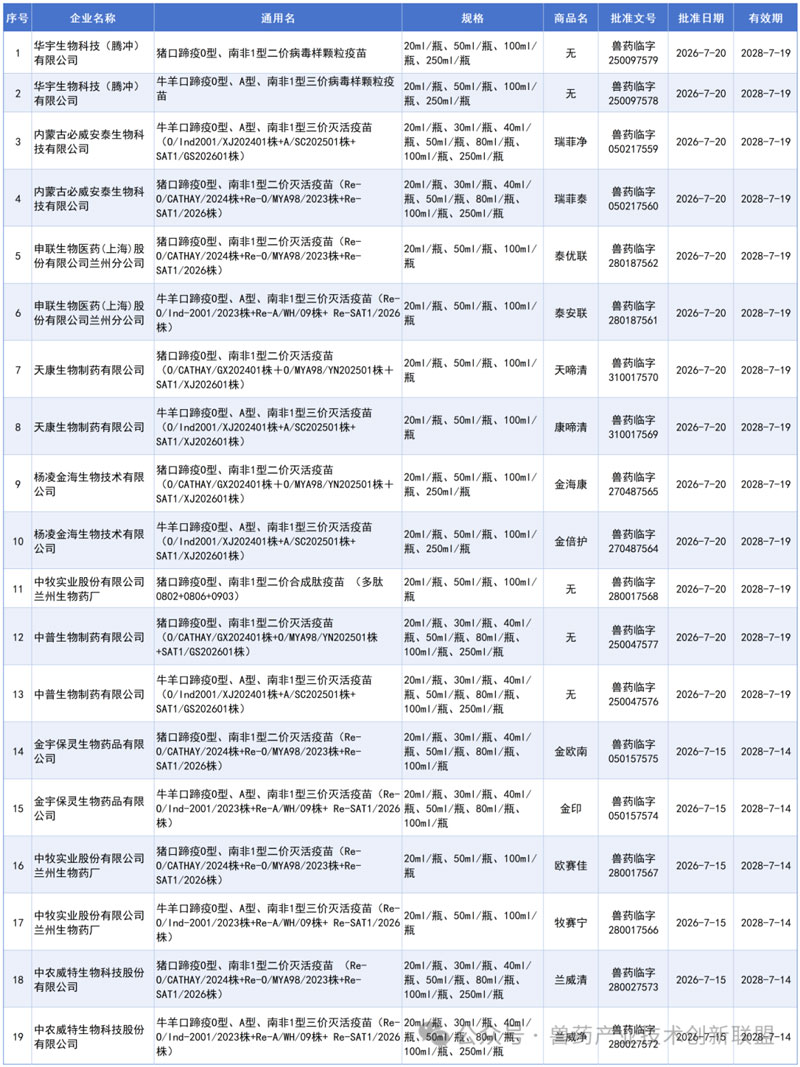
The image above shows the 19 SAT1 FMD-related products developed by nine companies.
The 15th Leman China Swine Conference & World Swine Industry Expo will be held from October 22 to 24, 2026, at the Zhongyuan International Convention and Exhibition Center in the Zhengzhou Airport Economy Zone.
The 2026 event is expected to reach a new record scale:
Approximately 120,000 square meters of exhibition space
More than 1,000 exhibiting companies
More than 150,000 professional visitorsThe conference and expo will bring together global industry leaders such as Boehringer Ingelheim, Zoetis and Muyuan Foods, along with leading companies from every segment of the pork value chain. Participants will present the latest technologies and integrated solutions covering genetics and breeding, disease prevention and control, smart farming, manure management and environmental protection.
Whether you are seeking a technological breakthrough, an upgrade to your production model or an integrated approach to disease prevention and control, the event will provide practical solutions to the challenges confronting today’s swine industry.
Companies across the global pork value chain are warmly invited to exhibit, and industry professionals worldwide are encouraged to register and attend.
This October, let us meet in Zhengzhou to shape the future of high-quality and sustainable development in the global swine industry.
Click the link to register now: https://s.31url.cn/rl9CH4Q9
Date: October 22-24, 2026
Venue: Central China International Convention and Exhibition Centre(Zhengzhou Airport Economy Zone),China

 Add:9 / F, Block A, Jinma Building, No.38 A, Xueqing Road, Haidian District
 Tel: 0086 10 62919126
0086 10 62956562
 E-mail:lemanchina@shixin-expo.com

Leman Wechat

WSE Wechat
Leman MP
Leman Tiktok